
1.Areas where personnel congregate shall not be located within the zones designated for smelting, casting, and overhead crane operations
(I) Major accident hazards in metallurgical enterprises: Locating areas where personnel congregate—specifically conference rooms, activity rooms, break rooms, control rooms, shift handover rooms, and changing rooms (including bathhouses)—or stations for the cold or hot repair of molten iron or steel ladles within the floor area of bays where molten iron, molten steel, or liquid slag is transported by overhead cranes.
(II) The regulation prohibiting the placement of areas where personnel congregate within the zones of smelting, casting, and overhead crane transport operations is based on the following critical safety considerations:
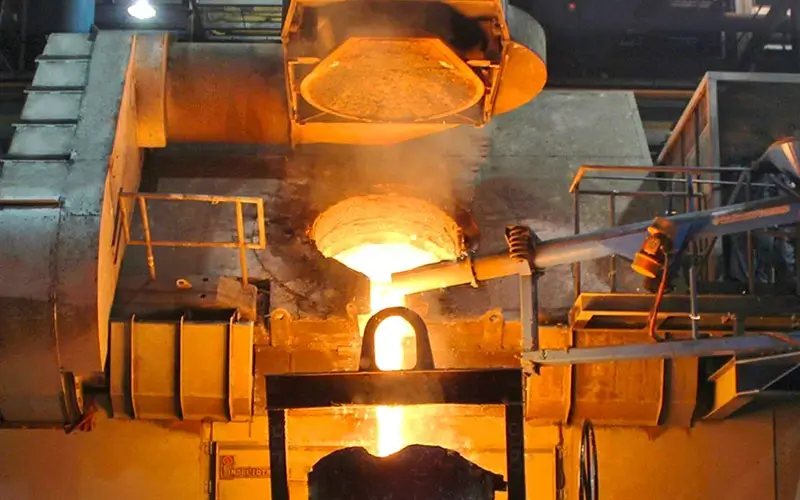
1) During the smelting process, the metal inside the furnace is in a high-temperature molten state, posing risks such as splashing or explosions. During casting, the flow of high-temperature molten metal is unpredictable; any leakage or spillage could cause severe burns to nearby personnel or even endanger lives.
2) During overhead crane transport, suspended heavy loads may accidentally fall or sway; if personnel are gathered underneath, this can easily result in major accidents involving casualties.
2.The induction coil water inlet line must be equipped with a quick-shutoff mechanism, and the cooling water system requires monitoring and alarm devices for pressure, flow rate differential, and temperature
(I) Monitoring and alarm devices must be installed for the medium-frequency furnace induction coil cooling system to track parameters such as inlet water pressure, the flow rate differential between inlet and outlet, and the outlet water temperature of each circuit. The alarm signals for inlet water pressure and the outlet water temperature of each circuit must be independently interlocked to cut off the medium-frequency power supply. Historical monitoring data must be accessible, alarm indicators must be positioned where operators on the furnace platform can easily observe and respond to them, and the monitoring and alarm system must be equipped with an uninterruptible power supply (UPS).
(II) The primary purpose of installing a rapid shut-off device for the induction coil inlet water line, along with monitoring and alarm devices for cooling water pressure, flow rate differential, and temperature, is to enhance the operational safety of the medium-frequency furnace. These measures facilitate the timely detection and resolution of potential cooling system issues, thereby preventing hazardous situations—such as equipment failure, fire, or even explosion—caused by inadequate cooling.
3.A partition wall must be installed between the power supply unit and the furnace body, and any openings where cables or components pass through walls or floors must be completely sealed
(I) When the medium-frequency furnace capacitor cabinet, power supply unit, and furnace body are located on the same floor, a partition wall must be installed between them, and any openings in walls or floors through which power lines pass must be sealed (except for integrated furnace bases or open-layout arrangements where the furnace body, capacitors, and control cabinet are mounted on the same base).
(II) Completely sealing wall and floor penetrations effectively prevents the transfer of dust, debris, flames, and high-temperature gases between different zones; this ensures the normal operation of the power supply unit and reduces the risk of safety incidents such as fires and short circuits, while also helping to maintain stable operating conditions—such as temperature and pressure—within the furnace body.
4.At least two emergency escape routes must be provided for the furnace platform
Establishing two or more emergency escape routes for the stove area is a crucial safety measure. Such an arrangement provides additional evacuation options in an emergency. If one escape route becomes blocked—due to fire, smoke, or obstructions—personnel can quickly switch to another, thereby increasing the likelihood of a successful escape.
5.Facilities such as emergency water sources, emergency power supplies, and emergency lighting must be installed
(I) Enterprises shall provide an emergency backup water supply for furnace body cooling, capable of automatic switching in the event of an interruption to the normal cooling water supply.
(II) Workplace lighting (including obstacle lighting and emergency lighting—such as backup, safety, and evacuation lighting) and minimum illuminance levels at work sites shall comply with the provisions of GB 50034.
(III) Emergency water sources shall be provided for water-cooled smelting furnaces/kilns, casting machines (excluding crystallizers used in deep-well casting processes for aluminum), and heating furnaces.
(IV) Emergency power supplies ensure the continued operation of critical equipment and systems—such as emergency communication devices, fire protection systems, and safety monitoring systems—during power outages, thereby maintaining effective emergency response and rescue operations.
(V) Emergency lighting provides necessary illumination for personnel evacuation and rescue operations during power outages or emergencies with insufficient light, helping people quickly locate safe exits and preventing panic and chaos.
6.Emergency storage facilities must be installed beneath and in front of the furnace and in the casting area; no accumulated water is permitted
(I) Major accident hazards in metallurgical enterprises: The presence of accumulated water in six specific types of areas during production operations—namely, accident pits and slag pits beneath furnaces in smelting, refining, and casting zones; furnace-front platforms and furnace foundation areas within the impact range of potential molten metal leaks or splashes; and overhead lifting routes or ground transport aisles within the plant building.
(II) Emergency storage facilities are installed to rapidly collect and contain molten metal, slag, or other hazardous substances in the event of an accident, thereby preventing further spread and more severe consequences. These facilities must possess sufficient capacity and structural strength to withstand high temperatures and potential physical impacts.
(III) The accumulation of water is prohibited because, upon contact with high-temperature molten metal, it rapidly vaporizes and triggers an explosion, leading to catastrophic consequences. Furthermore, accumulated water can impede the movement of personnel and increase the risk of slips and falls.
7.The use of aluminum-shell medium-frequency furnaces without magnetic yokes and with a nominal capacity of 0.25 tonnes or greater is prohibited
(I) Aluminum-shell medium-frequency induction furnaces without magnetic yokes (with a capacity of 0.25 tons or greater) are classified as production equipment explicitly ordered to be phased out by the state.
(II) The “Normative Conditions for Foundry Enterprises” explicitly require that enterprises refrain from using production equipment ordered to be phased out by the state—such as coreless power-frequency induction furnaces and aluminum-shell medium-frequency induction furnaces without magnetic yokes (with a capacity of 0.25 tons or greater).
