
Ladle refining is a new metallurgical process that has developed in recent years. Ladle refining involves moving almost all or part of the refining tasks—such as degassing, impurity removal, and composition and temperature adjustment—that would normally be performed in a traditional smelting furnace outside the furnace. Ladle refining of molten steel is also known as secondary steelmaking, and because most of the refining takes place inside the ladle, it is also called ladle metallurgy.
During ladle refining, the working environment for refractory materials in the ladle, permeable bricks, and lance is extremely harsh, leading to severe erosion and corrosion. Therefore, the selection of refractory materials is particularly important.
1.Refractory lining of steel ladle
Traditionally, the ladle serves as a storage and transport container between the steelmaking furnace and the ingot. However, ladle refining involves further refining within the ladle. Therefore, the operating conditions for the ladle lining are significantly worse: the molten steel temperature rises, the residence time in the ladle is prolonged, and the erosion and corrosion of the refractory material by the molten steel and slag become more severe. Previous refractory materials could not meet the requirements of ladle refining. Therefore, my country has developed various ladle lining refractory materials to meet the needs of steel mills. These mainly include the following:
(1) Alumina-Magnesium-Carbon Bricks
After Baosteel’s 300t steel ladle trial with alumina-magnesium-carbon bricks in 1990, they were rapidly adopted by many steel plants, becoming the main refractory material for the lining of large and medium-sized steel ladles in my country. At that time, Baosteel’s 300t steel ladle used alumina-magnesium-carbon bricks for the wall and magnesia-carbon bricks for the slag line. The tapping temperature was 1660–1670℃. The molten steel underwent RH vacuum degassing, KIP, and CAS ladle refining treatments. The alumina-magnesium-carbon bricks had only a thin layer of slag adhering to their surface, exhibiting good erosion resistance, no slag penetration, no thermal shock damage, and uniform erosion. Their average service life was 80 cycles, with a maximum of 126 cycles. Alumina-magnesium-carbon bricks are non-burning refractory products formed from a mixture of high-alumina clinker, magnesia, graphite, antioxidants, and phenolic resin binders. The process is relatively simple, the cost is low, and it is easily accepted by users.
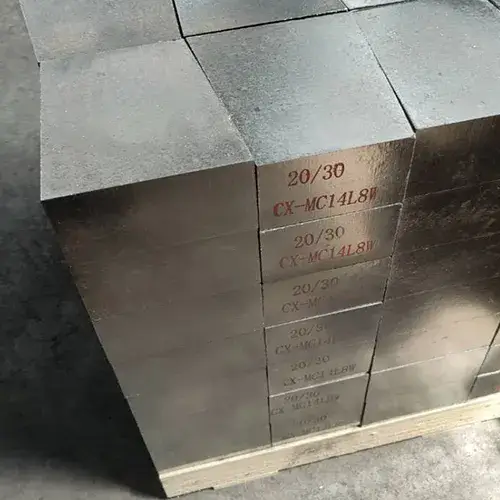
(2) Alumina-Magnesium Spinel Castable
In the mid-1990s, to adapt to ladle refining, high-grade alumina-magnesium spinel castables were adopted for the linings of some large and medium-sized steel ladles. The raw materials are fused alumina, sintered alumina, high-purity fused magnesia, and high-purity alumina-magnesium spinel, bonded with pure calcium aluminate cement, high-purity SiO2, and Al2O3 micro powder. Baosteel’s 300t ladle was used until 2000, with an average service life of 258 cycles; Shougang’s 90t LF refining ladle had a service life of 138 cycles, with an erosion rate of 0.62 mm/cycle; Benxi Steel’s precast components had a service life of 118 cycles, with a maximum of 126 cycles.
(3) Magnesia-calcium refractory materials
Taiyuan Iron & Steel Group (TISCO) used ordinary dolomite as raw material and medium-temperature pitch-bonded dolomite ramming mix. This mix was used on a 70t steel ladle, with an average service life of 76 cycles and a maximum of 112 cycles. Luoyang Refractories Research Institute (Luoyang Refractory Institute) developed non-fired magnesia-calcium bricks using synthetic magnesia-calcium sand and fused magnesia as raw materials, and solid inorganic salts and inorganic salt solutions as binders. These bricks were used on a 40t LF-VD refining ladle, achieving a service life of over 40 cycles, and reducing the oxygen content in the steel from 12.2 × 10⁻⁶. The value was reduced to 11.13×10⁻⁶. In the early 21st century, Shougang Group developed non-fired magnesia-calcium carbon bricks using synthetic magnesia-calcium sand, fused magnesia, and high-purity graphite as raw materials and anhydrous resin as a binder. These bricks were used in the non-slag line section of a 225t steel ladle (the slag line section uses magnesia-carbon bricks), achieving an average lifespan of 116.8 cycles. Compared to the original alumina-magnesia-carbon bricks, with a 20mm reduction in ladle wall thickness, the average lifespan increased by 35.57 cycles, and the oxygen content and non-metallic inclusions in the steel were also reduced. Some steel plants have also achieved good results using magnesia-calcium carbon bricks in the slag line sections of various steel ladles, such as SKF and LF-VD.
(4) Reducing the consumption of refractory materials in refining ladles
In my country, refining ladles accounts for over 70% of the total steel ladles, and the consumption of refractory materials for ladles accounts for over 30% of the total refractory material consumption in the iron and steel metallurgy industry. With the increase in the refining ratio, the unit consumption of refractory materials for ladles is increasing. my country’s refractory material consumption is generally considered to be 20 kg/t of steel, while advanced foreign countries consume 6-8 kg/t of steel. Reducing the consumption of refractory materials in steel ladles plays an important role in reducing costs, saving energy and reducing emissions.
Research was conducted on reducing refractory material consumption in a 60tLF steel ladle with a 100% refining ratio: 66% recycled magnesia-carbon bricks were used in the slag line, and 88% recycled alumina-magnesia-carbon bricks were used in the molten pool.
The measures to reduce unit consumption are as follows: design magnesia-carbon bricks according to the ladle operating conditions; increase the calcium content in the slag to reduce the erosion rate. The early slag of the ladle has a high FeO content, making the carbon in the bricks easily oxidized. To improve the oxidation resistance of the magnesia-carbon bricks, additives that increase the viscosity of fluorite slag are used. To reduce costs, used magnesia-carbon bricks are selected; operating conditions are improved by adopting slag retention after tapping, and reducing the FeO content in the slag by improving foam slag, thus increasing the ladle life by 20%; instead of SiC deoxidizer, a magnesia-calcium carbon ladle modifier with a carbon content of 15% (w) is used, increasing the slag line magnesia-carbon brick life by 15%; the maintenance system is improved by using 40mm thick secondary high-alumina bricks to patch the molten pool, increasing the life by more than 45%. In this way, the ladle life increases from 40-50 cycles to 88 cycles. After deducting the use of recycled materials, the resource consumption of refractory materials per ton of steel decreases from 9.3 kg to 1.4 kg, a reduction of 85%.
2.Argon-blown permeable bricks
Bottom-blown argon refining in steel ladles is widely used, and permeable bricks are a key functional refractory material in this process. Currently, permeable bricks at the bottom of the ladle have become a bottleneck limiting the lifespan of the ladle. The use of permeable bricks is intermittent and repetitive. Among the many factors affecting the lifespan of permeable bricks, thermal spalling and oxygen rinsing are significant causes of damage. The materials of permeable bricks are mainly chromium corundum and corundum-spinel, typically produced through casting and high-temperature firing. Because chromium corundum forms hexavalent chromium during high-temperature firing, polluting the environment, it is gradually being replaced by corundum-spinel. To improve the lifespan of permeable bricks, measures such as optimizing the batch composition, adjusting the cement content to control the CaO content in the castable matrix, increasing the formation of CA6 in the matrix to improve thermal shock resistance and structural reinforcement, adjusting the spinel particle size and amount, adding appropriate amounts of ZrO2 or zirconium corundum, and optimizing the firing temperature are taken to optimize the performance of the permeable bricks.
There are also non-oxide (Si3N4; Sialon) corundum permeable bricks. Field use shows that they have excellent thermal shock resistance, do not wet molten steel, have a high blow-through rate, are easy to clean with oxygen, have a low corrosion rate, and have a significantly improved service life.
3.Refractory materials for spray guns
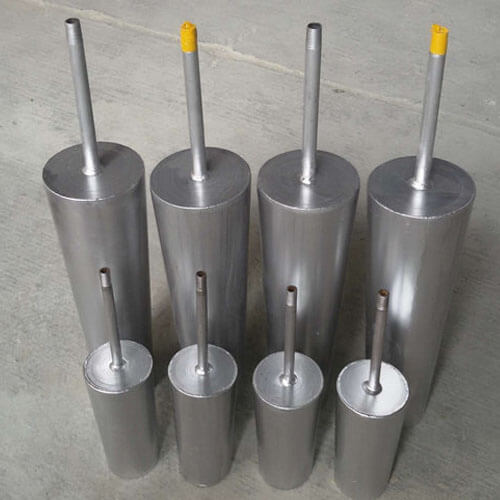
Powdered refining agents are injected into molten steel through a spray gun to refine it. For example, in the SL process, the powdered refining agent CaSi is injected into the molten steel using argon gas through a spray gun inserted deep into the ladle. Through gas agitation, the refining agent is thoroughly mixed and reacted with the molten steel. The refractory materials used in jet metallurgy spray guns operate under harsh conditions, including high steel temperatures and severe slag erosion and thermal shock damage. The integral spray gun structure developed by the Luoyang Refractories Research Institute uses corundum castable at the slag line, and castable above and below the slag line with an Al2O3 content of 70%–80%. Used in a 40t SL jet metallurgy unit, the spray gun has a service life of 15–19 cycles and a total blowing time of 95 minutes. Baosteel’s spray guns use fused corundum with an Al2O3 content of not less than 99%, reinforced with heat-resistant steel fibers, resulting in a service life of 10–20 cycles and a total blowing time of 100 minutes per gun, with a maximum of 188 minutes per gun.