
In the production processes of high-temperature industries such as steel, ceramics, cement, and glass, large quantities of refractory materials are consumed, resulting in a significant amount of waste refractory materials; in addition, the production of refractory products themselves generates a large amount of defective products and refractory waste. Of this massive volume of waste refractory materials, only a very small portion can be returned to the production line for reuse, while the vast majority is either landfilled as waste or used for lower-grade applications. Furthermore, waste refractory materials cause environmental pollution, primarily in the following ways: (1) dust; (2) silicosis caused by crystalline silica; (3) radioactivity from zirconia raw materials; (4) the carcinogenicity of Cr⁶⁺; (5) the carcinogenicity of refractory fibers and asbestos; (6) pollution from volatile components in bitumen and resins; (7) land occupied by waste refractory materials. If the millions of metric tons of spent refractory materials generated annually in China could be fully utilized as secondary resources, it would not only conserve a significant amount of resources for the country but also generate annual social benefits exceeding 10 billion yuan. To this end, technical research and development has been conducted on recycled ladle hearth bricks and permeable hearth bricks from waste refractories, resulting in the development of corundum castables containing recycled ladle hearth brick material, which have achieved excellent performance.
1. Experiment
1.1 Materials and Experimental Protocol
Alumina castable is prepared using 95% brown fused alumina, recycled ladle nozzles, and air vent bricks as aggregates; white fused alumina powder, micro-alumina powder, and #92 silica fume as the matrix; and Secar-71 cement as the binder.
1.2 Sample Preparation and Property Testing
Specimens were prepared in accordance with YB/T 5205.1—2003; the water content added to the specimens when the flow values of the castables were similar is shown in Table 3. Using the above mix ratios, prepare nine sets of test specimens measuring 160 mm × 40 mm × 40 mm. After curing and demolding, dry the specimens at 110°C for 24 h, then test for apparent porosity, bulk density, flexural strength, and compressive strength; The dried specimens were heat-treated at 1100°C for 3 h and at 1500°C for 3 h, respectively, followed by measurement of apparent porosity, bulk density, flexural strength at room temperature, compressive strength, and linear change rate after firing. At the same time, a slag resistance test was conducted on crucible specimens fired at 1500°C for 3 hours, adding 50 g of slag. The chemical composition (by weight) of the slag was as follows: Al₂O₃ 11.81%, Fe₂O₃ 1.05%, SiO₂ 36.82%, CaO 22.65%, MgO 21.79%, MnO₂ 3.79%.

2.Results and Analysis
2.1 Effect of the Amount of Recycled Refractory Aggregate Added on the Room-Temperature Properties of Castable Refractories
As the proportion of recycled ladle water seat bricks and vent seat bricks increases, the water content of the corundum castable gradually rises, the apparent porosity increases, and the bulk density decreases. This is primarily because, after the recycled ladle water seat bricks and vent seat bricks are crushed, most of the particles are pseudo-particles with a higher water absorption rate than new material; therefore, more water is required to achieve proper wetting and meet the forming requirements. As the proportion of recycled ladle water seat bricks and vent seat bricks increases, the room-temperature strength of the test specimens shows a downward trend. This is because, after drying by holding at 110°C for 24 hours, the strength of the corundum castable is primarily related to the hydration products of the cement. The hydration of aluminate cement produces CAH10, C2AH8, and C3AH6 crystals, as well as AH3 (alumina gel), which form a coagulation-crystallization network to generate bonding strength. At this temperature, as the amount of water added increases, the porosity rises, and the strength decreases accordingly. After treatment at 1100°C for 3 hours, the hydrated mineral phases lose some or all of their crystalline water and undergo partial phase transformation. This phase transformation releases a large amount of free water, leading to a looser specimen structure, increased porosity, and reduced strength of the castable. In contrast, after holding at 1500°C for 3 hours, a large number of interlaced CA2 and CA6 crystal networks form in the matrix, strengthening the bond between the matrix and the aggregate particles and thereby increasing the strength.
2.2 Effect of the Amount of Recycled Clinker on Slag Resistance
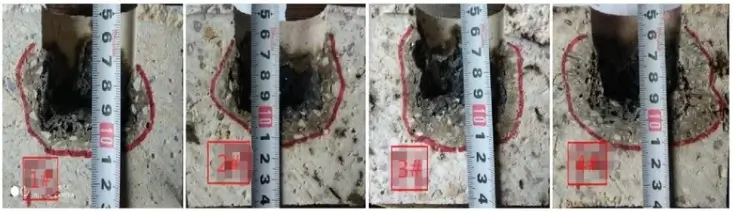
After holding at 1500°C for 3 hours, the longitudinal cross-sections of the slag-resistant specimens for each formulation are shown in Figure 2. It can be observed that as the proportion of recycled ladle nozzle and breather seat bricks increases, the slag resistance of the corundum castable gradually decreases. An increase in water content leads to a decrease in the bulk density of the corundum castable and an increase in porosity, making it easier for slag from the intermediate ladle to penetrate the specimens, thereby correspondingly reducing their slag resistance. When the proportion of recycled ladle nozzles and air-permeable seat bricks was ≥45% (w), the slag resistance of the samples had already decreased significantly and could not meet operational requirements. To address the slag resistance issue, the following experiments involving the addition of chromium oxide were conducted.
2.3 Effect of Chromium Oxide Powder on Corundum-Based Self-Flowing Refractory Mixes
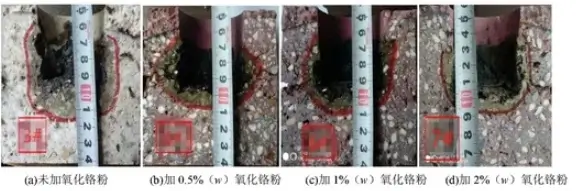
As shown in Figure 3, the slag resistance of the corundum castable—which contains recycled ladle nozzles and base bricks—improved significantly after the addition of chromium oxide powder; when the chromium oxide powder content exceeded 1% (w), the slag resistance of the castable continued to improve, though the increase was not substantial. This is because, once the temperature rises to 1400°C, chromium oxide begins to dissolve into the alumina matrix. This solid solution promotes the sintering of the corundum castable matrix, with chromium oxide gradually bonding the corundum particles to the matrix, thereby enhancing the castable’s high-temperature strength. As the amount of chromium oxide in solid solution increases, the liquidus temperature also rises. Upon contact with furnace slag, the Al₂O₃ in the solid solution gradually melts into the slag, while Cr₂O₃ precipitates from the refractory material in the form of a chromium-rich (Cr, Al)₂O₄ solid solution, forming a protective layer of chromium-rich (Cr, Al)₂O₄ at the interface between the refractory material and the slag, thereby preventing further slag intrusion. Therefore, the appropriate addition of chromium oxide powder can significantly improve the slag resistance of the castable and extend its service life. Taking into account on-site application and economic considerations, the addition of chromium oxide powder is set at 1% (w).
3.Conclusion
In corundum castables prepared using recycled ladle nozzles and air vent seat bricks, considering factors such as suitability and cost-effectiveness, the optimal formulation consists of 45% (w) recycled ladle nozzle and air vent seat brick particles and 1% (w) chromium oxide powder. The prepared corundum castable was tested on the 120-metric-ton ladle at Kunming Iron and Steel’s New Plant and met the operational requirements.