
In steelmaking, the ladle is the core piece of equipment for holding and transporting molten steel; the stability of its refractory lining directly impacts safety, production pacing, and maintenance costs.
However, technical and procurement staff at many steel plants often struggle to clarify the distinctions between the ladle’s permanent lining and its working lining: Can the same material be used for both? What are the common pitfalls in material selection?
For many enterprises, issues such as poor thermal insulation, shell overheating, the risk of steel breakouts, and frequent repairs stem from a fundamental confusion regarding the functions of the two lining layers, as well as errors in material selection and installation.
Ladle lining structure
The ladle lining structure consists of two layers: an outer permanent layer (for thermal insulation and structural support) and an inner working layer (for corrosion and erosion resistance). In short:
Working layer = Direct contact with molten steel; withstands erosion and corrosion; prone to wear.
Permanent layer = Provides insulation and structural integrity; prevents accidents; long service life without replacement.
The operating conditions, functions, and material selection criteria for these two layers differ completely; materials must never be mixed, substituted, or swapped.
Refractory lining for the working layer of a steel ladle
The working layer is the innermost refractory layer of the ladle that comes into direct contact with molten steel and slag at high temperatures; as a consumable refractory component, it is the part of the ladle that wears down the fastest and requires the most frequent replacement.
Core role
- Directly withstands immersion in molten steel at temperatures exceeding 1600°C and high-speed erosion;
- Resists chemical corrosion during slag contact, desulfurization, and refining processes;
- Endures thermal shock caused by frequent tapping and pouring operations.
Performance requirements
High strength, high density, resistant to slag erosion and thermal shock, erosion-resistant, and non-spalling.
Commonly used materials
Corundum-based castables, high-strength high-alumina castables, magnesia-alumina spinel materials, and specialized ladle repair/gunning mixes.
Replacement interval
Cyclic wear: periodic repair, spraying, or complete relining, depending on the steel grade and furnace condition.
Material Selection and Combination
1.Standard steel grades and conventional operating conditions → High-alumina, high-strength castables
2.Refined steel, low-sulfur steel, and harsh slag conditions → Corundum/spinel-based high-strength castables
3.Routine rapid maintenance and localized wear → Specialized ladle gunning mixes and repair materials
Permanent lining refractory for steel ladles
The permanent lining is situated between the working lining and the steel ladle shell; as a structural, long-lasting refractory component, it does not come into contact with molten steel under normal operating conditions and does not require frequent replacement throughout its service life.
Core role
1.Thermal insulation: Retains the temperature of the molten steel, minimizes heat loss, and reduces energy consumption during steelmaking;
2.Structural support: Provides a flat, stable foundation to support the working lining;
3.Safety backup: Prevents molten steel from penetrating through to the shell in the event of localized failure of the working lining, thereby averting catastrophic “breakout” accidents;
4.Shell protection: Prevents the ladle shell from overheating, glowing red, or deforming.
Performance requirements
Good thermal insulation, dimensional stability, moderate strength, low thermal conductivity; does not crack or crumble.
Commonly used materials
Specialized permanent lining castables for steel ladles, lightweight insulating castables, and high-strength insulating refractory materials.
Replacement interval
Under normal operating conditions, it remains in service alongside the ladle for an extended period, requiring virtually no frequent dismantling or replacement.
Material Selection and Combination
Prioritize the use of specialized insulating castables for steel ladles: they offer stable thermal insulation, dimensional stability, crack resistance, and structural integrity, effectively reducing the temperature drop of the molten steel and protecting the ladle shell.
Permanent Layer vs. Working Layer: Key Differences
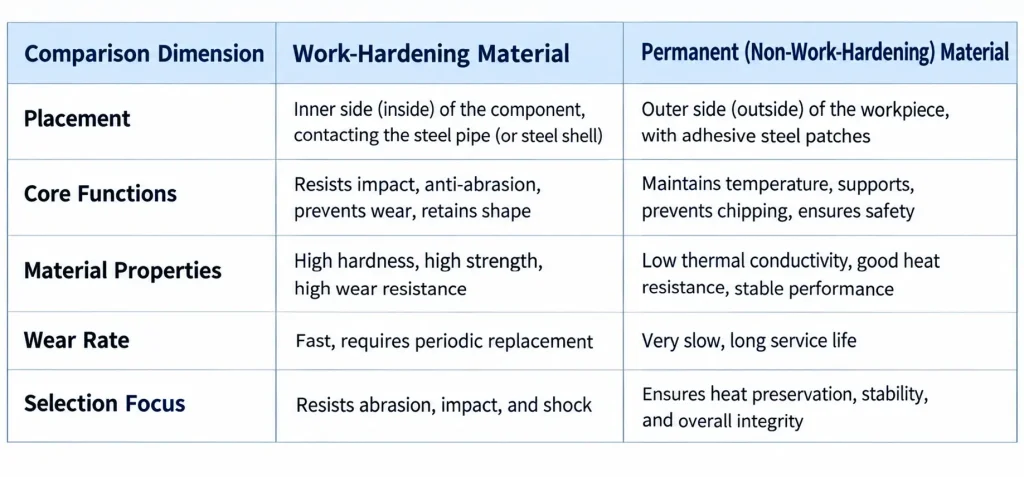
Common Construction Misconceptions
Misconception 1: Mixing and Misusing Materials Between Layers
Using permanent-layer insulation material for the working layer results in insufficient density and poor slag resistance, making it highly susceptible to rapid erosion and perforation; using high-end working-layer material for the permanent layer leads to excessive performance and a severe waste of resources.
Misconception 2: Cutting Corners During Permanent Layer Construction
To cut costs, the layer is made too thin, not properly compacted, or constructed with substandard materials, leading to insulation failure, reddening of the steel shell, and the risk of steel penetration.
Misconception 3: Blindly Pursuing “Hard and Expensive” Materials for the Working Layer
Failing to match materials to the slag type and steel grade, and blindly using high-end materials results in extremely low cost-effectiveness and severe long-term waste.
Misconception 4: Neglecting the Treatment of the Interface Between the Two Layers
An uneven surface, loose dust, or hollow spots on the permanent layer lead to delamination, spalling, and overall loosening of the working layer later on.
Misconception 5: Limiting Maintenance to the Working Layer While Neglecting Inspection of the Permanent Layer
After long-term production, the permanent layer may also develop cracks and powdering; failure to inspect and address these issues promptly can create major safety hazards.