
The factory currently has five 210t converters, as well as refining equipment such as CAS, LF, and RH, producing a wide range of products including pipeline steel, automotive steel, shipbuilding steel, and silicon steel. Prior to 2009, the ladle refractory bricks used were internally packed. In the production of low-end steel grades and when the requirements for bottom blowing effect were not too stringent, the service life could typically reach about 38 cycles, meeting the needs of the production process. With the continuous improvement of slab steel quality, and to meet the process requirements of desulfurization and alloying, and to significantly improve the blowing effect of the refractory bricks, a bottom blowing and purging process was introduced. However, purging led to increased corrosion and spalling of the refractory bricks and their base bricks, reducing the safety of the refractory bricks and ladle lining bricks. The drawbacks of internally packed refractory bricks gradually became apparent, becoming a major obstacle to the development of refractory materials for Shougang Qian’an Steel’s ladles. This article focuses on the application practice of externally packed refractory bricks in Shougang Qian’an Steel’s ladles, and the technical measures taken to ensure safety.
Application Overview of Bottom-blown Permeable Bricks
After continuous casting is completed and the ladle returns to the hot repair station, the permeable bricks are typically purged based on the results of permeability checks to ensure the blowing yield and bottom blowing effect for future use. Shougang Qian’an Steel, after adopting the permeable brick purging process, increased the blowing yield from approximately 90% to over 99%, basically meeting the requirements for high-quality steel grades. However, this reduced the service life of the permeable bricks from approximately 38 uses to approximately 22 uses, and the residual thickness of the permeable bricks decreased from approximately 220mm to 160-180mm, reducing the safety of their use and significantly impacting the stable turnover of the ladle.
To ensure the blowing effect of the permeable bricks, as well as their safe service life and residual thickness, the height of the permeable bricks was increased in 2008. Simultaneously, adjustments were made to the ladle bottom repair process and the ladle turnover process. The residual thickness of the permeable bricks was restored to 180-200mm, the bottom blowing life stabilized at around 24 cycles, and the blowing success rate stabilized at over 99%. However, the 24-cycle service life of the internally installed permeable bricks still did not match the scheduled maintenance frequency of the corresponding ladle lining. Replacing the permeable bricks required removing the ladle from normal turnover before the operation could proceed, which affected the service life of the ladle working lining, the ladle hot turnover efficiency, and the stable turnover of the ladle to varying degrees. Therefore, realizing online hot replacement of permeable bricks has become an essential requirement for improving the bottom blowing brick usage process.
Comparison of externally mounted permeable bricks and internally mounted permeable bricks
1.Overall Structure and Installation Operation Characteristics
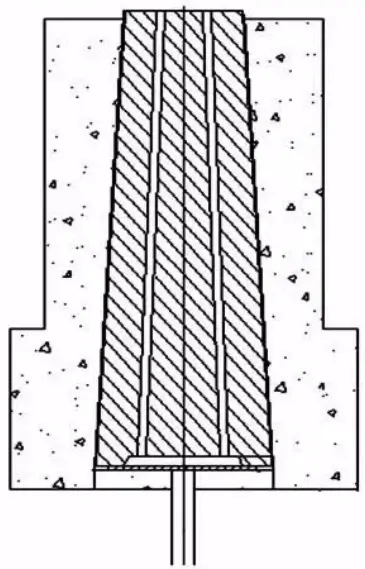
The core and base bricks of the internally installed permeable bricks are assembled as a whole before entering the factory. During the steel ladle construction, the bricks are installed from inside the steel ladle without any auxiliary mechanisms, as shown in Figure 1.
The core and seat brick of the externally mounted permeable brick are separate, requiring a special auxiliary mechanism to ensure safe use. The structure of the externally mounted permeable brick mainly consists of four parts: bottom blowing mechanism, pad brick, permeable seat brick, and permeable brick core, as shown in Figure 2.
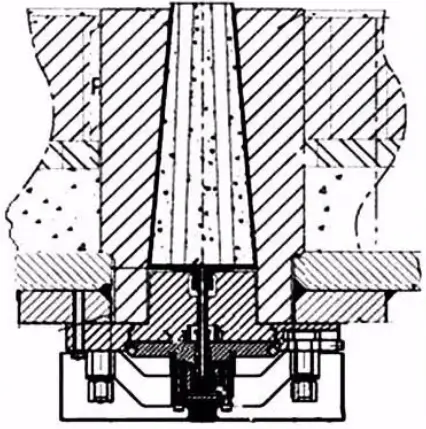
For externally mounted vent bricks, the base brick is installed from inside the ladle during ladle construction, while the vent brick core is installed from the outside of the ladle. After the vent brick core is installed, a support brick is placed beneath it and secured in place by the bottom-blowing mechanism.
2. Gas Supply Methods
Although internal and external vent bricks differ in structure, there is no significant difference in their gas supply methods. Currently, the main gas supply methods include slit-type, plate-type, and annular-seam-type.
3. Maintenance Methods
If the core of an internally mounted vent brick suffers severe erosion or if bottom blowing becomes consistently obstructed, a ladle shake-out must be performed. This involves removing the vent seat brick and core once the ladle lining temperature has cooled to a level tolerable for operators, and then relining with new bricks; In contrast, for externally mounted vent bricks, the brick cores can be replaced while the ladle is still hot. The vent seat bricks do not need to be replaced. Once the brick core replacement is complete, the externally mounted vent bricks can be put into service immediately without the need for additional drying or baking.
Physical and Chemical Properties of Refractory Materials for Ventilation Systems
Currently, externally mounted permeable bricks using steel ladles employ plate-shaped permeable brick cores. Unlike internally mounted permeable bricks, due to erosion and pore enlargement caused by purging during use, newly installed permeable plugs require special thermal repair material to fill the gap between them and the permeable base bricks.
Problems encountered in the practical application of externally mounted permeable bricks
Since the application of externally mounted permeable bricks in 210t ladles is unprecedented, and their use in ladles of 200t and above in domestic steel mills is also relatively rare, there is relatively little experience to draw upon. Based on the experience of Qian’an Steel over the past few years, the following situations require attention:
(1) Failure to pull out the permeable brick core during hot replacement, extending the replacement time. Under the conditions of using the permeable brick core, improper operation when using a dedicated permeable brick core pulling tool to pull out the externally mounted permeable brick core can cause the outer iron sheath of the permeable brick core to break, resulting in some permeable brick core remaining inside the seat brick. This necessitates the use of tools such as pneumatic picks to remove it from the outside of the ladle, causing the bottom-blowing replacement operation to take more than 3 hours.
(2) Damage to the permeable seat brick caused by purging operations. During hot ladle repair, purging the permeable brick core will cause it to corrode faster than the permeable seat brick, resulting in it sinking into the seat brick. After the permeable seat brick loses its dependence on the permeable brick core, the inner cavity of the permeable seat brick is in direct contact with the molten steel. During use, it is subjected to repeated thermal shock from the repeated circulation of molten steel, which easily leads to the phenomenon of permeable seat brick breakage. This causes a safety hazard of steel leakage due to bottom drilling in the ladle. At the same time, the injected Ar gas flows out from the break, weakening the bottom blowing effect and affecting normal process processing.
(3) The lifespan of the permeable brick core does not match the ladle’s scheduled maintenance mode, resulting in increased consumption of permeable brick cores. The maintenance mode of Shougang Qian’an Steel’s 210t carbon-free steel ladle is: 48 heats ~ 72 heats ~ 96 heats ~ 120 heats, that is, the bottom brick is replaced at 48 heats, the slag line brick is replaced at 72 heats, the bottom brick is replaced at 96 heats, and the ladle is taken offline for mid-term maintenance at 120 heats. Because the service life of the permeable brick core after heat replacement is relatively shorter than that of the permeable brick core installed in the new ladle bottom, with the ladle bottom life set at 48 cycles, each permeable seat brick uses an average of ≥3 permeable brick cores, resulting in an excessive consumption of permeable brick cores and failing to fully realize the efficiency of the external permeable brick technology. Statistical analysis of the service life and residual thickness of a large number of permeable brick cores on site (see Table 2) revealed that the permeable brick cores installed in the newly constructed ladle bottom have a relatively longer service life, while those after heat replacement have a relatively shorter service life, which has a certain impact on the overall turnover of the steel ladle; it also increases the consumption of permeable brick cores, with an average consumption of more than 14 per ladle, and a maximum consumption of 18.
(4) Misjudgment of the purging of the permeable brick core affects the bottom blowing effect. Due to the instability of the permeable brick core manufacturing quality and the influence of the on-site purging operation, the permeability of the permeable brick core may be insufficient when the steel ladle is sent to the refining station for processing. This makes it difficult to meet the requirements of the refining process, and the molten steel has to be poured into another steel ladle for further processing, which has a certain impact on the normal production rhythm and increases production costs.
Improvement measures and effects
To address various problems encountered during the use of externally mounted permeable bricks, a series of improvement measures were formulated through strengthened on-site management, yielding significant results.
(1) To address the issue of failed core pulling during hot replacement and the resulting long replacement time, it was required that residual steel and slag adhering to the permeable brick core surface be thoroughly blown away during core replacement, and that the fire mortar adhering to the back seat of the permeable brick core be completely removed. Before pulling, the permeable brick core was tapped, and the strength of the bottom steel shell of the permeable brick core was increased, significantly improving the success rate and efficiency of bottom-blown brick replacement.
(2) Regarding the blowing operation of bottom-blown bricks, a permeable brick blowing operation specification was formulated, clearly defining the requirements for blowing gas flow rate, blowing angle, and blowing time, improving operators’ ability to judge bottom-blown brick breakage and blockage.
(3) Measures to match the service life of permeable bricks with maintenance. For localized pits appearing in the permeable brick core during use, timely repair materials were applied to ensure the permeable bricks operate safely.
(4) To address issues encountered during the use of permeable bricks on-site, the “Management Requirements for the Use of Permeable Bricks” were formulated to standardize on-site management by suppliers and strengthen communication and coordination between suppliers and ladle preparation personnel. A detailed dynamic record of permeable brick usage inspections was established to promptly identify problems and quickly find corresponding solutions.
Through these technical measures and management improvements, Shougang Qian’an Steel’s external permeable brick blowing success rate has reached over 99.9%, achieving a 100% success rate in permeable brick core pulling and significantly shortening the heat replacement time of permeable bricks. The service life of permeable brick cores has stabilized at 24-28 cycles, with a residual thickness greater than 200mm, reducing permeable brick consumption. The phenomenon of permeable seat brick breakage has disappeared, greatly improving the safety of external permeable brick usage. Furthermore, in the four years since the improvements, the service life of external permeable bricks has been well-matched with the maintenance mode of the ladle lining, laying the foundation for further extending the lifespan of the ladle.
In summary, the use of externally mounted permeable bricks on 210t ladles, along with refined and standardized technical operation management, enhanced dynamic inspection and monitoring of the permeable bricks during daily use, and improved operational efficiency, enabled rapid repair of ladles without removing them from the production line. This accelerated ladle turnover, improved the safety of ladle turnover, ensured the timely tapping of molten steel from the ladle, and laid the foundation for reducing the system’s molten steel temperature.