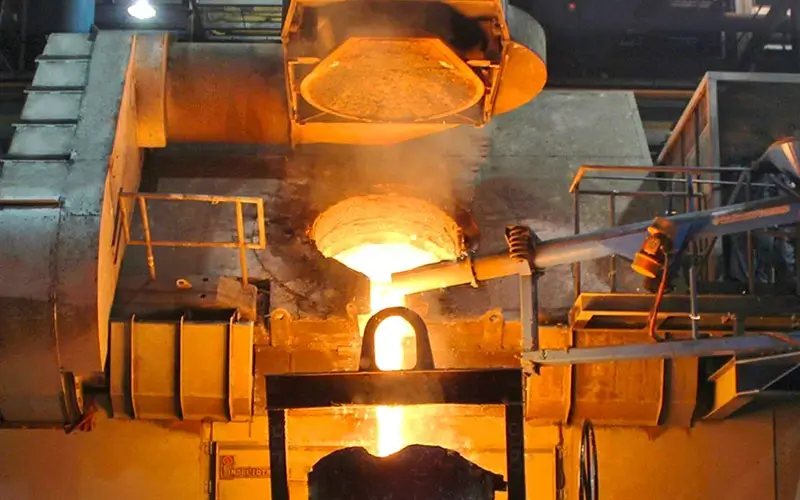
What is medium-frequency furnace steelmaking?
Medium-frequency furnace steelmaking is a process that uses eddy currents generated by a medium-frequency magnetic field to melt scrap steel, which is then processed through continuous casting and rolling mills to produce steel products. The products resulting from this process are no longer the “substandard steel bars” of the past. According to research by relevant organizations, there are currently about 70 medium-frequency furnace steel mills in China, with a production capacity of approximately 100 million tons; however, actual output fluctuates significantly. In early February of this year, due to a slump in the construction steel market coupled with falling prices for imported iron ore—which reduced the costs of the blast furnace-converter process—IFF steel mills lost their competitiveness and nearly all suspended operations. However, by July, as demand for construction steel grew and iron ore prices rose, output from IFF steel mills surged rapidly, reaching an annual production level of 50 million tons. It is projected that IFF steel mills will produce approximately 40 million tons this year.
Compared to converter and electric arc furnace steelmaking, the most significant difference with medium-frequency furnace steelmaking is that it cannot use oxygen blowing to produce slag. Consequently, it cannot remove harmful elements such as phosphorus and sulfur from the molten steel; in particular, it cannot reduce phosphorus content, resulting in steel that is highly prone to brittle fracture. This type of steel can only meet “strength” requirements but fails to meet “toughness” requirements. It is suitable only for applications such as concrete blocks for land reclamation, concrete barriers for highways, and support frames for vegetable greenhouses. Its scope of application is limited, and it cannot be widely used in the construction sector.
Which standards should not be applied to steelmaking in medium-frequency furnaces?
In accordance with the spirit of comprehensively deepening reform, the government should use administrative measures in accordance with the law to phase out medium-frequency furnace steelmaking capacity, primarily by applying standards related to environmental protection, energy consumption, and product quality. The author will now provide a brief analysis of the feasibility of these approaches:
First, regarding environmental protection. Medium-frequency furnace steelmaking does not involve oxygen blowing or slag formation, and emits less smoke, dust, and pollutants than converter or electric arc furnaces, resulting in relatively lower levels of environmental pollution. Therefore, compliance with environmental protection indicators should not be used as the primary basis for phasing out medium-frequency furnace steelmaking capacity.
Second, regarding energy consumption. When comparing consumption indicators from key production stages, converted to energy consumption per ton of steel (kilograms of standard coal per ton of steel): the electricity consumption per ton of steel in medium-frequency furnace steelmaking ranges from 600 kWh to 700 kWh, which translates to an energy consumption of 242 kg to 282 kg of standard coal (based on a conversion rate of 0.404 kg of standard coal per kWh of electricity). Electric arc furnace producers, taking into account factors such as steel quality, generally require the addition of 700 kg to 800 kg of relatively pure hot molten iron per ton of steel. This reduces electricity consumption per ton of steel from approximately 500 kWh to 150 kWh to 200 kWh, equivalent to 60 kg to 80 kg of standard coal; However, molten iron serves as an energy carrier. Calculated at 460 kg of standard coal per ton of iron, adding 700 kg to 800 kg of molten iron per ton of steel equates to an energy consumption of 322 kg to 368 kg of standard coal. Combined, the energy consumption per ton of steel is 382 kg to 448 kg of standard coal, which is higher than that of medium-frequency furnaces. Therefore, energy consumption should not be used as the primary basis for phasing out medium-frequency furnace capacity.
Third, regarding quality. Most of China’s construction steel enters the construction sector through distribution channels, and the supply and demand of steel are governed by national standards. However, national standards have a very broad scope, covering steel for the most basic applications and lowest grades. They set relatively low requirements for steel quality and performance, particularly regarding phosphorus and sulfur content, which have a wide permissible range with an upper limit of 0.045%. Furthermore, there are no minimum requirements for elements such as manganese and silicon that enhance steel performance. In other words, under current standards, construction steel products can be produced without any alloying. These are standards that can generally be met by medium-frequency furnace production. However, such steel exhibits very poor toughness and is highly prone to brittle fracture, making it unsuitable for widespread use in the construction sector, particularly for mid- to high-rise buildings and infrastructure.
Therefore, establishing and refining quality standards for construction steel based on specific applications, while strictly restricting the entry of medium-frequency furnace steel into the construction sector, constitutes the most critical regulatory basis for eliminating its production capacity.

How should the production capacity of medium-frequency furnaces be regulated in accordance with the law?
The author argues that to strengthen the management and control of production capacity in medium-frequency furnace steel mills—an area currently operating in a “gray zone”—appropriate policy support should be provided at the policy level. This should include strengthening the oversight of medium-frequency furnace steel producers, refining quality standards for construction steel, and promoting the effective restructuring of assets.
First, medium-frequency furnace steel producers should be brought out of the “underground” and into the “open,” placing them under the framework of legal regulation. Based on the quality grades and intended uses of their products, these enterprises can be classified according to the principles of “prohibited use” and “permitted use,” and managed through laws and regulations. We anticipate that, given the current quality of steel produced by medium-frequency furnace enterprises, the vast majority of medium-frequency furnace capacity will fall into the “prohibited for use” category; a small number of enterprises that use high-quality scrap steel may enter limited low-end markets. The author recommends that, over the next five years, medium-frequency furnace capacity be incorporated into the overall plan for capacity reduction, with governments at all levels responsible for implementation, public disclosure, and performance evaluation.
Second, classify by application and refine quality standards for construction steel. The author suggests organizing efforts to refine quality standards based on current regulations, to serve as the legal framework for addressing medium-frequency furnace steelmaking capacity. Standards could be established primarily based on the content of harmful elements such as phosphorus and sulfur. For example, usage scope could be divided into three categories:
Category I: Phosphorus and sulfur content not exceeding 0.045%, used for general facilities not intended for human habitation (such as vegetable greenhouses, livestock pens, and cement blocks for land reclamation) and low-rise buildings in non-seismic zones.
Category II: Phosphorus and sulfur content not exceeding 0.03%, used for mid- to high-rise buildings and general infrastructure.
Category III: Phosphorus and sulfur content not exceeding 0.02%, used for high-rise buildings and critical infrastructure.
Third, restructure viable assets. The author suggests that after eliminating medium-frequency furnace capacity, the government should encourage enterprises to merge continuous casting machines, rolling mills, and other viable assets with other competitive enterprises, and provide policy support in areas such as capacity replacement, adjustment of energy consumption and environmental protection indicators, and cross-regional tax allocation.
The idea that intermediate frequency furnaces are synonymous with substandard steel production is clearly a misunderstanding.
It is a common misconception that medium-frequency furnaces produce poor-quality steel.
With the advancement of medium-frequency furnace technology and the government’s efforts to phase out outdated production capacity, the medium-frequency steelmaking process has undergone continuous improvements. Not only has the steelmaking capacity of medium-frequency furnaces been expanded to ensure furnace stability, but the quality of raw materials has also been enhanced by increasing their purity and employing methods such as oxygen or argon blowing to remove impurities. This results in purified molten steel with uniform composition, thereby ensuring the quality of the raw materials.
In the stainless steel industry, where production requirements are stricter than those for carbon steel, manufacturers primarily use pure scrap stainless steel as raw material, allowing for better control of its composition. Furthermore, to further enhance product quality, many medium-frequency furnace enterprises have also equipped their facilities with AOD and LF refining furnaces. Currently, many of our exported specialty products are also produced using medium-frequency furnaces.
Many large steel mills also have plans to install intermediate frequency furnaces.
Due to its fast melting speed, excellent energy-saving performance, minimal burn-off, low energy consumption, and uniform melting temperature and metal composition, the medium-frequency furnace achieves a 100% startup rate regardless of whether the furnace is empty or full, making it highly suitable for the production of small batches of specialty materials.
With the increase in domestic crude stainless steel production, the supply of stainless steel scrap is also growing. The abundance of raw materials and the variety of smelting processes have led many large steel mills to launch plans to install medium-frequency furnaces. Moreover, strictly speaking, aren’t the vacuum induction melting furnaces commonly used in stainless steel production today also a type of medium-frequency furnace?
Note: A vacuum induction furnace is a complete set of vacuum smelting equipment that utilizes medium-frequency induction heating principles to melt metal under vacuum conditions.
Therefore, we cannot make a blanket assumption that steel produced by medium-frequency furnace mills is necessarily “substandard steel.” The term “substandard steel” more specifically refers to low-quality steel produced in small, workshop-style facilities. These operations lack continuous casting and rolling capabilities, use extremely small induction furnaces, and directly cast low-quality steel by melting inferior scrap metal—resulting in products whose quality and safety cannot be guaranteed.
In summary, the public debate surrounding “substandard steel” stems primarily from an unclear definition of the term. For carbon steel, the definition of “substandard steel” is clear and unambiguous. However, for stainless steel, the concept remains vague and is plagued by inconsistencies.