
The ladle porous plug is a critical functional component in the secondary refining process and a key material for bottom argon-blowing operations; it serves the following primary functions:
(1) It helps regulate the temperature distribution of the molten steel within the ladle, ensuring the optimal casting temperature for the process.
(2) Through gas-blowing agitation, it ensures the uniform distribution of alloying elements and deoxidizers within the ladle.
(3) It facilitates the transport of non-metallic inclusions from the molten steel into the slag, thereby meeting the required cleanliness standards for the steel.
To achieve these functions, inert refining gas is injected into the ladle through the porous plug. At the interface between the plug and the molten steel—specifically the plug’s working face—the gas is forced out under sufficient pressure to form a high-volume jet of bubbles. This jet agitates the molten steel, promoting flow and homogenizing both temperature and chemical composition throughout the ladle. Simultaneously, the continuously rising bubbles carry non-metallic inclusions into the slag, effectively purifying the molten steel.
To fulfill the aforementioned metallurgical functions, gas-permeable bricks must possess the following key properties:
(1) Good gas permeability. Permeability is a crucial parameter for evaluating the quality of gas-permeable bricks. Research indicates that the stirring energy imparted to the molten steel is directly proportional to the flow rate of the injected gas; stirring energy directly dictates stirring efficiency, and sufficient energy is required to achieve effective agitation of the molten steel. At a constant argon flow rate, a higher number of injected argon bubbles enhances both degassing and stirring performance.
(2) High-temperature corrosion resistance. Refining ladles operate under stringent temperature and duration requirements; peak temperatures often exceed 1750°C, and refining cycles can last for tens of minutes. During refining, slag basicity significantly impacts the service life of the gas-permeable bricks. Consequently, these bricks are susceptible to rapid degradation caused by highly penetrative basic slag at elevated temperatures.
(3) High-temperature wear resistance. During bottom argon injection in refining ladles, the rapid flow of molten steel intensifies the erosive wear on the lining materials, bottom gas-permeable bricks, and their seating blocks. During hot maintenance, oxygen blowing is employed to clean residual steel and slag from the brick surface and restore permeability by melting the adhered material; simultaneously, gas is injected through the brick to blow away the molten slag. This cleaning process subjects the bricks to high-velocity gas streams, necessitating excellent high-temperature wear resistance.
(4) Good thermal shock resistance. Ladles operate intermittently; when molten steel is poured in, the face of the gas-permeable brick is exposed to high temperatures, causing a sudden rise, while the subsequent injection of argon cools the material, generating significant internal thermal stress. Furthermore, the introduction of molten steel into an empty ladle induces drastic temperature fluctuations. These harsh operating conditions make the bricks highly susceptible to thermal spalling and structural spalling.
(5) Ease of installation, safety, and reliability. The porous plug is installed within the bottom well block of the steel ladle. Due to the extremely harsh operating conditions, the service life of the porous plug does not match that of the ladle itself, necessitating periodic replacement. Consequently, the installation process must be simple, and the operation safe and reliable, to prevent incidents such as steel seepage or leakage.
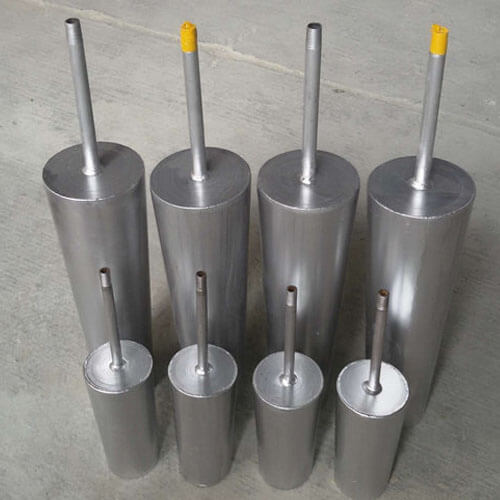
Common Classifications of Ladle Purging Plugs
After years of development, there are three main structural types of gas-permeable bricks: the diffuse type, the slit type (including monolithic cast and assembled-plate varieties), and the straight-through microporous type.
The diffuse-type gas-permeable brick represents the earliest form of this technology. Due to the material’s high inherent porosity, the abundant pores provide channels for inert gas flow. However, this type suffers from low strength and poor erosion resistance; it is susceptible to penetration by molten steel and slag—leading to spalling—and offers relatively poor stirring efficiency. Consequently, it is rarely used in ladle gas-permeable bricks in China today.
Slit-type gas-permeable bricks come in two forms. The first is the “assembled-slit” type, where the central section consists of several assembled thin plates forming slits, encased in castable material; the drawback of this design is limited control over the injected gas. The second is the standard “slit-type,” featuring dozens of straight-through slits pre-cast directly into the brick body. Compared to the assembled-slit variety, this standard slit-type brick offers advantages such as a longer service life, a higher gas-blowing success rate, greater gas flow capacity, and superior stirring performance.
Compared to diffuse-type porous plugs, slit-type porous plugs possess higher density and exhibit superior resistance to erosion and oxygen cleaning.
Straight-channel porous plugs are manufactured by embedding a number of fine steel tubes into the brick body, creating gas passages composed of numerous straight, micro-fine channels; they are formed using a casting process. Compared to diffuse-type plugs, straight-channel plugs offer superior stirring efficiency and a service life that is two to three times longer. However, they have the disadvantage of limited gas flow capacity; in the later stages of use, refining operations often fail because the gas flow rate drops or the channels become completely blocked.
Gas permeability is commonly evaluated using the “blow-through rate.” This metric primarily assesses whether the plug performs its fundamental function of allowing gas passage—a key performance indicator for steelmakers—and is valued for its operational convenience, having gained widespread acceptance across the industry. However, as steel quality requirements rise, relying solely on the blow-through rate as a functional metric is somewhat incomplete. Permeability can be further broken down into several specific indicators: blow-through rate, maximum flow rate, flow controllability, initial start-up performance, and bubble characteristics.
The need for rapid ladle turnover—requiring high stirring energy within a minimal timeframe—led to the introduction of the “maximum flow rate” metric. This rate depends on the plug’s structural design and its rated flow capacity. Slit-type plugs are typically designed for higher flow rates than other types; consequently, large-capacity ladles (exceeding 300 tonnes) predominantly utilize slit-type plugs. Flow controllability refers to the ability to adjust flow via pressure; ideally, the flow rate should increase in tandem with the pressure. Good initial start-up performance indicates that the gas channels open rapidly under relatively low “crust-breaking” pressure.
Extensive research indicates that diffuse-type porous plugs produce smaller gas bubbles; furthermore, at an equivalent flow rate, they generate a greater number of bubbles than slit-type plugs. This abundance of small-diameter bubbles facilitates the adsorption of fine non-metallic inclusions; as the bubbles rise, they carry these inclusions upward, where they are ultimately captured by the slag layer. These permeability characteristics are advantageous for removing non-metallic inclusions from the molten steel during soft-stirring operations. However, diffuse-type porous plugs struggle to meet the flow rate requirements for intensive gas purging in large-capacity ladles; furthermore, they suffer from rapid erosion and wear during such operations, resulting in a shorter service life.
Compared to diffuse-type plugs, slit-type porous plugs offer significant advantages in terms of meeting flow rate requirements. However, for special steels requiring high purity, their overall metallurgical performance is inferior.
We have previously shared details regarding steel breakout incidents involving ladle porous plugs at several companies; the primary causes are as follows:
- Issue of Excessively Short Brick Core
The gas-permeable brick is located at the very bottom of the ladle and must withstand the hydrostatic pressure of the molten steel during operation. When the residual length of the brick core is too short, the contact area between the core and the seating brick decreases, and the structural strength of the core itself is compromised, making it prone to cracking under thermal shock (rapid heating and cooling). If the pressure-bearing capacity of the brick core falls below the hydrostatic pressure of the molten steel, the core may be dislodged, or molten steel may penetrate through cracks in the brick body, leading to a steel breakout accident.
- Excessive Oxygen Content
The argon gas used during the molten steel refining process requires a purity of 99.99%; no oxygen contamination is permitted. However, some steel plants use lower-purity argon, resulting in oxygen contamination. This oxygen causes secondary oxidation of the molten steel, impairing the refining results. During gas purging, the reaction between oxygen and molten steel generates temperatures as high as 2000°C, accelerating surface melting and erosion of the gas-permeable brick. The scouring action of the gas flow rapidly erodes the brick, shortening its service life and—in severe cases—causing steel breakouts. Whether the brick is of the slit, ceramic rod, or diffuse type, none can withstand the melting and erosion caused by the reaction between oxygen and molten steel.
- Steel Breakout at the Refractory Mortar Joint (Between Brick Core and Steel Shell)
During on-site assembly, a uniform layer of refractory mortar must be applied to the exterior of the brick core; the joint thickness is generally required to be 2–3 mm. Operating procedures dictate that the brick core must be horizontally aligned with the inner bore of the seating brick, and care must be taken during installation to ensure the mortar at the bottom of the core is not scraped off by the seating brick or other objects. Uneven application or the loss of mortar during installation results in an uneven mortar layer—thick on one side and thin on the other. The thicker side is susceptible to erosion by the molten steel, thereby reducing the brick’s service life. In the later stages of use, molten steel can penetrate through the mortar joint, easily leading to a breakout. If mortar is scraped off on one side, a gap remains because the steel casing cannot bond perfectly with the seating brick’s inner bore; the high-temperature atmosphere then gradually oxidizes and erodes the steel casing, further increasing the risk of a steel breakout.
- Steel leakage through the refractory mortar joint between the porous plug core and the steel casing
Causes: 1) During installation, the lower part of the porous plug core was not tightly pressed against the bottom plate; during operation, the core shifted slightly downward, creating a gap between the core and the steel casing that allowed molten steel to seep through. 2) During operation, excessive gas-blowing pressure caused the plug core to shift slightly upward, loosening the initial tight fit; if the plug subsequently settled back down due to external forces when gas flow ceased, a gap formed between the core and the steel casing, leading to steel leakage during subsequent use. 3) The refractory mortar used during installation failed to sinter at low temperatures, resulting in low strength; during operation, turbulence from the gas flow gradually eroded mortar from the bottom, creating a void between the plug core and the steel casing. Molten steel then seeped down through this gap into the gas chamber, resulting in leakage through the mortar joint.
- Steel leakage through slits
Improper slit design. The design of slits in slit-type porous plugs is critical; it must ensure adequate gas permeability while preventing excessive molten steel penetration, which could clog the slits and render the plug impermeable. Currently, slit widths typically range from 0.15 to 0.2 mm. Given the wettability between molten steel and refractory materials, preventing steel penetration entirely is impossible; however, minor penetration does not impede gas flow. If one or more slits are excessively wide, molten steel penetrates the slits and solidifies (“cold steel”), clogging them and preventing gas from passing through.
These are the common causes of damage to porous plugs
- Spalling of the porous plug core
When a ladle is transferred to the converter after hot repair, the internal temperature is approximately 900°C, whereas the converter’s end-point temperature is generally around 1630°C. The rapid thermal cycling caused by this temperature difference leads to spalling of the porous plug core, typically resulting in a spalled layer 10–20 mm thick. Furthermore, due to the tapered design, the spalled section does not detach completely but remains in place, impairing gas permeability for the current heat of steel.
- Fracture of the porous plug seating block
Rapid thermal cycling can also cause the seating block of the porous plug to fracture, with the fracture occurring at a height of 100–200 mm. Deprived of the seating block’s protection, the plug core becomes susceptible to erosion by molten steel and may also fracture. Such fractures pose a severe risk; particularly during the late stages of the plug’s service life, the shortened residual brick increases the likelihood of steel breakouts through the ladle bottom.
- Low strength and poor erosion resistance
During hot repair, an oxygen lance is used to clean the porous plug at a standard rate of 9–12 mm per heat. If the material lacks sufficient strength, the core height drops significantly with each cleaning cycle. Consequently, the plug fails to reach its intended service life and is taken out of commission prematurely, disrupting normal ladle turnover and causing production instability.
- Damage from molten steel scouring and erosion
When inert gas is injected through the porous plug, the gas flow exerts an impact force on the exposed area surrounding the plug. The interaction between the high-speed molten steel flow and the gas creates turbulent eddies. If the porous plug protrudes above the seating block, the protruding section is subjected to scouring and shear forces from these eddies, resulting in the formation of an annular groove.
- Damage from excessive oxygen lancing
If residual steel in the ladle is not promptly drained after continuous casting, a layer of solidified steel forms on the ladle bottom. Oxygen lancing—specifically directing the lance against the plug core—is required to clear this buildup; however, this direct application causes rapid burn-off of the plug core.
- Off-center burning of the porous plug core
When cleaning the plug with an oxygen lance, the oxygen stream is concentrated on a single point on the core. This can easily lead to uneven burning, resulting in a slanted rather than flat core surface, with a height differential exceeding 50 mm. If a gas-permeable brick suffers from uneven burning, its permeability is compromised; furthermore, the cleaning process exacerbates this unevenness, leading to premature decommissioning.
- Low back-purge gas pressure
Nitrogen is used as the back-purge gas at a pressure of 0.5 MPa, whereas the oxygen pressure for the oxygen lance during cleaning is 0.8 MPa. During oxygen cleaning, molten steel is forced into the narrow slits of the gas-permeable brick; upon cooling, it clogs these slits, impairing gas permeability. Subsequent hot repair and cleaning operations further accelerate the erosion of the gas-permeable brick core.
- Detachment of corundum material and ladle bottom bricks surrounding the gas-permeable brick
During the lining of the ladle bottom, a 50–100 mm wide layer of self-flowing corundum material is cast around the gas-permeable brick’s seating block to protect it. Due to insufficient strength of the self-flowing corundum or construction defects, this material may detach, allowing molten steel to seep in and fracture the seating block; alternatively, if the surrounding ladle bottom bricks fracture, the resulting steel seepage can cause the surrounding corundum material and the seating block itself to break.