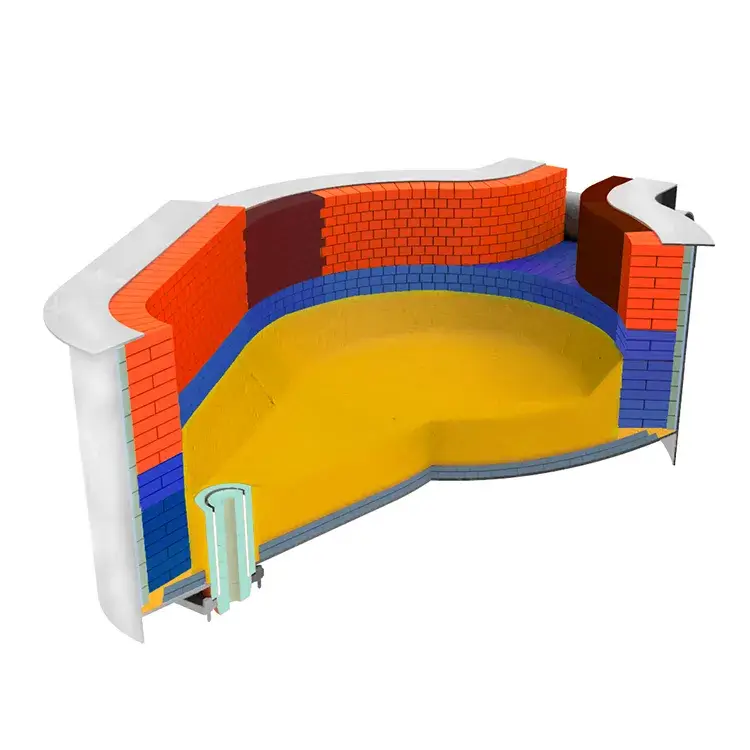
Electric furnace covers are subjected to both high temperatures and frequent rapid heating and cooling, placing high demands on refractory materials. The refractory materials used in electric furnace covers in my country have evolved from initially using large, specific silica composite bricks, to non-fired high-alumina bricks prepared with various binders (water glass, phosphoric acid, aluminum dihydrogen phosphate, etc.), or by introducing sillimanite group mineral raw materials into the batching process, adding micronized powder, spinel, silicon carbide, etc. In recent years, various refractory castables have been developed to meet the needs of ultra-high power electric furnaces. The refractory materials used in electric furnace covers are as follows:
High-alumina brick furnace cover
my country has abundant and diverse high-alumina bauxite resources, providing favorable conditions for the development of advanced alumina refractory materials. High-alumina bricks with corundum as the main crystalline phase can be used in the furnace covers of ultra-high-power electric furnaces, with a service life of approximately 150 heats. Preventing spalling and improving erosion resistance are key to delaying the damage of refractory bricks.
Furnace cover bricks containing “three stones”
The “three stones” (sillimanite, kyanite, and andalusite) belong to the sillimanite group and are allotropic. Their theoretical composition is Al₂O₃: 53.1% and SiO₂: 36.9%. All three mineral raw materials are high-alumina minerals and possess the properties of high-alumina minerals. When heated to a certain temperature, the “three stones” irreversibly transform into mullite crystals (exhibiting a short columnar and needle-like network structure).
The expansion rate of the “three stones” is related to the purity, particle size, and impurity composition and content of each mineral. Andalusite and sillimanite, due to their small volume expansion and good volume stability during the transformation to mullite, can be directly used in brick making without pre-firing or partially introduced. Kyanite, with its large volume expansion, can be used as an expanding agent in monolithic refractories or partially introduced into brick making.
Unfired furnace cover bricks
Unfired furnace cover bricks are a new variety developed this year. Their advantages include simplified production process, energy saving, and good thermal shock resistance and erosion resistance. However, their structural strength is slightly inferior, and their performance and storage period are greatly affected by packaging methods and the environment. Adding SiC, MgO, Al2O3, C, etc. to high-alumina unfired bricks and then lightly pouring oil for impregnation is an effective measure to improve the high-temperature performance of furnace cover bricks. Chemical composite bricks with added SiC have good thermal shock resistance and erosion resistance.
Integral cast furnace cover
Precast refractory bricks, primarily made of corundum, chromium corundum, high-alumina, and mullite, are used in the triangular area of the electric furnace cover. These precast refractory bricks offer good integrity and corrosion resistance, simplify construction, and ensure relatively high quality, significantly improving the overall quality of the electric furnace cover.
Generally, the triangular area of an ultra-high power electric furnace cover uses corundum (chromium corundum) precast components. High-alumina and mullite precast blocks are widely used in the triangular area of high-power electric furnace covers.