
The design of the electric furnace, as well as the selection and arrangement of the refractory materials used for its lining, significantly influence the operating cycle of the converter. The following details the design of the electric furnace’s roof, hearth, and furnace chamber, along with the configuration of the refractory materials utilized for the lining.
EAF roof
The roof of the electric furnace features an arched profile. The furnace roof is substantial in mass; for a brick-lined 5-ton electric furnace, the roof weighs nearly 5 tons, while for water-cooled roof designs, the weight can exceed 10 tons. The smaller central section of the furnace roof typically utilizes prefabricated blocks, or alternatively, fully water-cooled or semi-water-cooled roof components. The electric furnace roof is subjected not only to high-temperature environments but also to frequent and drastic thermal shocks—rapid fluctuations between high and low temperatures—thereby imposing rigorous demands on the refractory materials employed.
Initially, furnace roofs were primarily constructed using silica bricks, which possess a refractoriness ranging from 1690°C to 1710°C. However, as the intensity of electric furnace smelting increased—leading to elevated furnace temperatures—and given the inherent limitations of silica bricks regarding resistance to thermal shock and alkaline slag erosion, silica brick roofs could no longer meet operational requirements.
Currently, high-alumina bricks—characterized by excellent resistance to thermal shock and a refractoriness of 1750–1790°C—are predominantly used for constructing furnace roofs. A drawback of high-alumina bricks in service is their relatively poor resistance to lime dust and iron-oxide-bearing basic slags at high temperatures; under the influence of lime dust and iron oxides, the bricks undergo progressive spalling layer by layer, or even melt, and upon entering the slag, they cause the slag to become excessively fluid. Consequently, some plants have adopted alumina-magnesia bricks—which possess a higher refractoriness (approximately 2100°C) and superior resistance to basic slags—for constructing the main sections of the furnace roof, while retaining high-alumina bricks only in the vicinity of the electrode ports and charging ports. For ultra-high-power electric arc furnaces, water-cooled roofs are employed; specifically, the smaller roof sections surrounding the electrodes are constructed using high-alumina refractory precast blocks featuring external water-cooling rings.
Furthermore, the inner surface area of a brick-masonry arch roof is smaller than its outer surface area; this geometry allows for the use of wedge-shaped bricks—wider at the top and narrower at the bottom—which interlock tightly with one another, thereby significantly enhancing the stability of the arch. In actual smelting operations, the central section of the furnace roof—particularly the area containing electrode ports—typically experiences the shortest service life. Incorporating a certain degree of arch curvature helps distance this central section from the high-temperature zone within the furnace, thereby contributing to an extended service life for the roof. However, this curvature must not be excessive; otherwise, during the tapping process, the roof bricks become prone to dislodging and falling into the furnace.
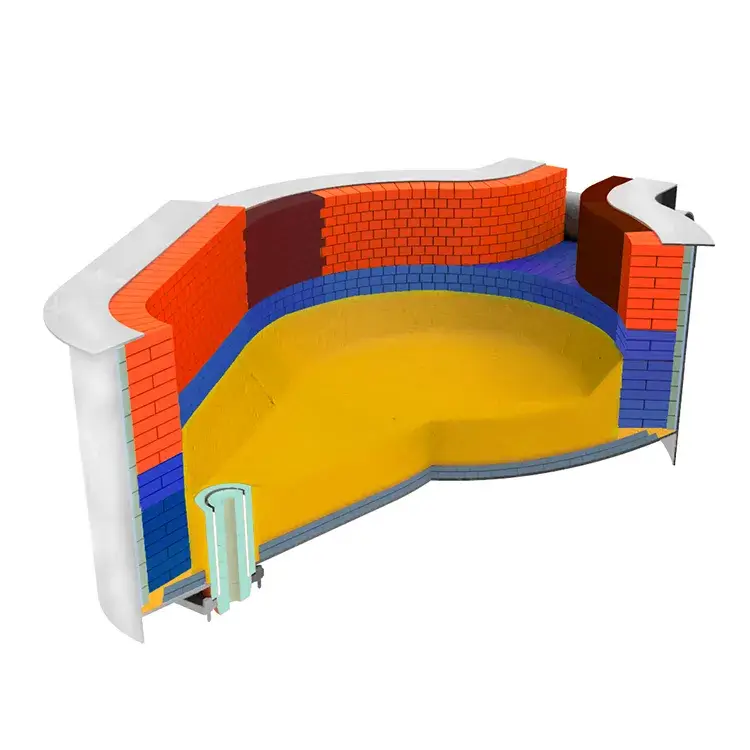
Electric Furnace Hearth
The lower section of an electric furnace, which serves to contain the molten steel during the refining process, is known as the furnace hearth. Typically, the hearth features a combined spherical and conical geometry: the very bottom is spherical, while the molten pool assumes the shape of a truncated cone. The conical side walls are inclined at an angle of 45° relative to the vertical axis, and the height of the spherical base accounts for approximately 20% of the total depth of the molten steel. The spherical base serves a crucial function during the initial stages of melting by facilitating the rapid accumulation of molten steel; this not only protects the furnace bottom—preventing the electric arc from making direct contact with the refractory lining—but also accelerates the melting process, enabling the slag to effectively blanket the molten steel and thereby minimizing gas absorption and heat loss. Furthermore, the 45° inclination of the conical section ensures that the molten steel can be completely tapped when the furnace is tilted by approximately 40°, while also facilitating the hot repair operations of the furnace lining.
EAF Furnace Chamber
In an electric furnace, the furnace chamber refers to the section situated above the hearth, comprising a structure of water-cooled panels. The furnace chamber is a critical zone, serving the essential functions of accommodating charge material and facilitating metallurgical processes. Typically, the furnace chamber assumes the shape of a truncated cone. The inclination angle of the furnace walls generally ranges between 6° and 7°; this specific slope is designed to facilitate furnace refractory maintenance and patching operations. An excessive inclination angle would result in an increased furnace shell diameter, leading to greater heat loss and necessitating larger mechanical support structures. The height of the furnace chamber is defined as the vertical distance from the sloping plane of the molten pool (specifically, the junction of the furnace wall and the hearth) to the upper rim of the furnace shell. It is imperative to maintain the furnace chamber at a reasonable height to prevent overheating of the furnace roof and to ensure that the charging of subsequent batches of material is not impeded. If the furnace chamber is excessively high, heat dissipation losses increase, and the required ceiling height of the plant building must be correspondingly raised. Generally speaking, for small electric furnaces with a capacity of less than 5 tons, the ratio of the furnace chamber height to the molten pool diameter falls between 0.5 and 0.6; for furnaces with a capacity of 10 to 40 tons, this ratio ranges from 0.45 to 0.5; and for furnaces ranging from 80 to 180 tons, the ratio lies between 0.4 and 0.45. As the capacity of the electric furnace increases, the relative height of the chamber decreases; this design approach aims to shorten the lengths of the electrodes and busbars—thereby minimizing electrical resistance and impedance—while simultaneously allowing for a reduction in the required height of the plant building.
More details about EAF furnace
What is an EAF furnace?
An electric arc furnace (EAF) is an industrial furnace that uses high-voltage electric arcs between graphite electrodes and metallic charge (usually scrap steel) to melt and refine metal. Operating at temperatures up to 3,000°C, EAFs are primarily used in steelmaking to recycle scrap metal into new steel, offering higher efficiency and lower carbon emissions than traditional blast furnaces.
What is the difference between BF BOF and EAF?
EAF steelmaking relies on electricity and recycled metals, Blast Furnace/BOF depends on raw materials like Iron Ore and Metallurgical Coke as part of a process where oxygen is blown into the furnace at a high velocity.
What is EAF used for?
An electric arc furnace (EAF) is a type of furnace used in steelmaking that utilizes electric arcs to melt steel scrap or other raw materials. The EAF operates by passing a powerful electric current through electrodes to generate intense heat, which melts the steel in the furnace.
How does an EAF furnace work?
An Electric Arc Furnace (EAF) melts scrap steel by using high-power electric arcs generated between graphite electrodes and the metal charge. The process, reaching temperatures over 3,000°C, involves lowering electrodes to initiate an arc, melting the scrap, adding fluxes to form slag for removing impurities, and tapping the molten steel.
How common are electric arc furnaces?
Electric-arc furnaces, which use electricity to generate heat, offer a low-carbon alternative to blast furnaces. A new analysis from Global Energy Monitor, a San Francisco-based think tank, found that 43 percent of planned steelmaking capacity globally will rely on electric-arc furnaces, up from 33 percent last year.